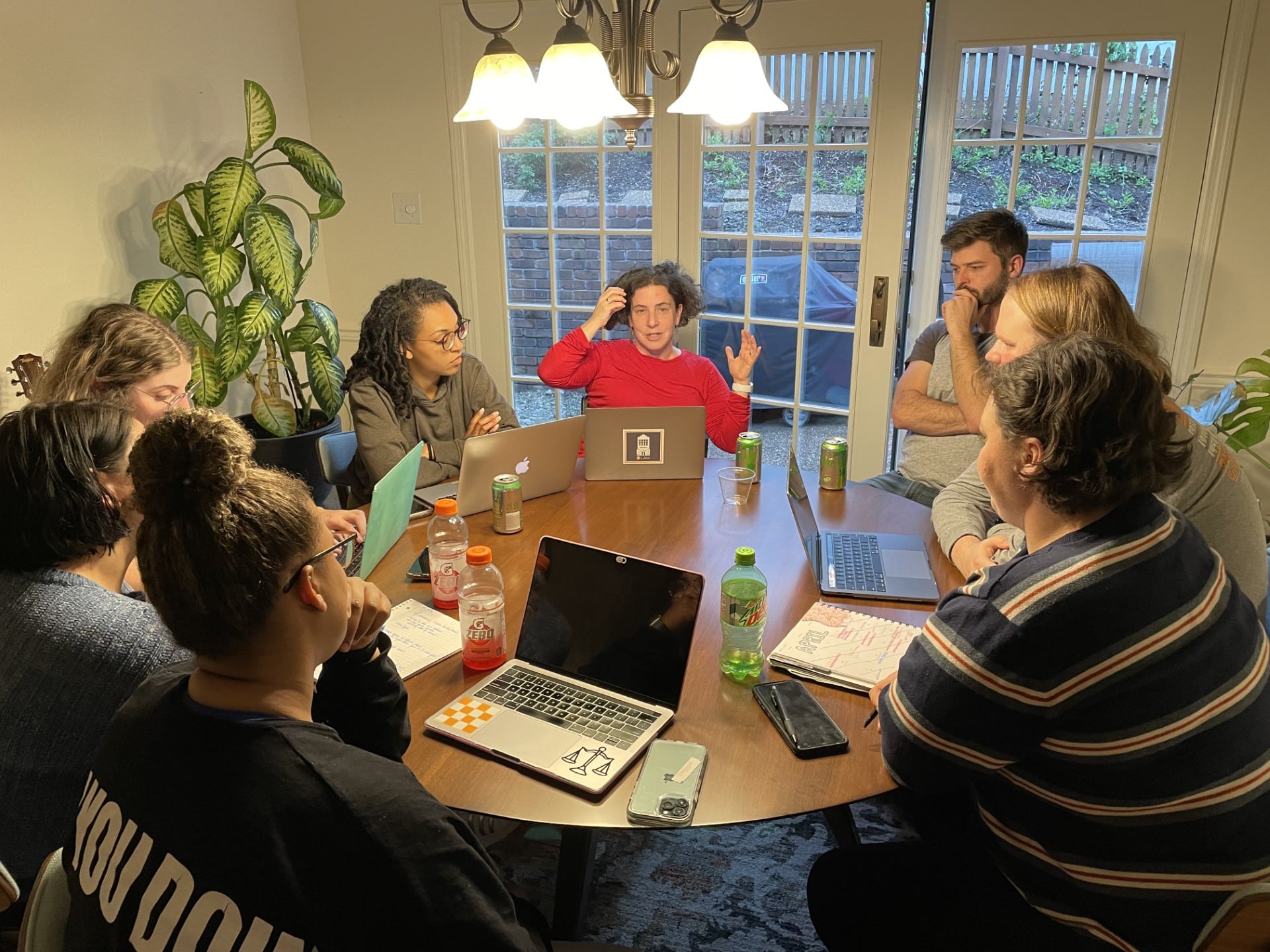


Socio-legal research team seeks to understand pregnancy criminalization in Appalachia and beyond

Professor Wendy Bach isn’t new to conversations about the impact of systems of care and punishment on poor communities. Bach’s nearly 30-year career has been dedicated, both in scholarship and practice, to work at the intersections of poverty law, criminal law, and social welfare provision. In 2022 she published her first book, Prosecuting Poverty, Criminalizing Care, which shares findings from Bach’s empirical study of Tennessee’s fetal assault law.
Over the course of studying and writing her book, Bach built relationships with individuals and families who had been criminalized by these laws as well as organizations across the country who offer support to those experiencing pregnancy criminalization. One of those organizations was Pregnancy Justice, a nationwide non-profit dedicated to advancing and defending individuals charged with pregnancy-related crimes.
“After the Dobbs Supreme Court decision, the staff at Pregnancy Justice and I realized there was a need for rigorous research on this topic and decided to see what we could accomplish together,” said Bach.
The resulting project is an expansive transdisciplinary, community collaborative partnership to track cases of pregnancy criminalization across the country. Working across disciplines has allowed the research team to develop and implement novel case identification techniques. The methods established by the team will help other scholars, advocates, and communities identify and research a variety of cases in the criminal legal system.
The transdisciplinary nature of the project also creates compelling training opportunities for UTK students and early career scholars. Dr. Kendra Hutchens joined the project as the Appalachian Justice Research Center’s first postdoctoral research fellow. She leads the qualitative component of the study, to provide data to illuminate the effects of these prosecutions on people’s lives. As a sociologist, Hutchens was drawn to the project for both its unique approach and the opportunity to conduct research that lives in spaces beyond the academy.
“Social scientists do not receive many opportunities for postdoctoral training,” explains Hutchens, “which is an incredible way to learn from others to broaden and deepen your methodological and substantive expertise. As an early career scholar, I feel so grateful to be able to contribute to a project of this scale and scope as part of a transdisciplinary team.”
The project team also consists of law faculty and law students from two universities. Han Lemberg is a 2025 graduate of the University of Tennessee Winston College of Law who worked on the project for a year and a half. Lemberg was the AJRC’s first graduate research assistant and recently began their new role as a public defender at the Kentucky Department of Public Advocacy.
For Lemberg, this project was an opportunity to hone their skills reading and interpreting legal documents, conducting legal research when information was not readily available, and understanding the complexities of criminal code. Importantly, this project also offered Lemberg insights for their law career as a public defender that a classroom alone could not teach.
“Working on this project made me connect the skills I was learning in law school to the realities of the criminal legal system,” shared Lemberg. “It deepened my understanding of how overlapping systems – the family regulation system, law enforcement, the health care system, the school system – can contribute to feelings of fear that impact our clients and create unforeseen barriers to trust-building and representation. As a public defender, it’s critical that I show up for clients with that awareness and the skills to navigate these real-life challenges.”
Like most research at the AJRC, this project brings together law students as well as undergraduate and graduate students in a wide array of disciplines. Perri Mahfouz is a senior in the College Scholars Program who began working on the project after taking the Appalachian Justice Research Lab course. Through the Lab, Mahfouz connected with Bach and expressed her research interest in reproductive health and pregnancy criminalization. Bach recommended a research internship with Pregnancy Justice, and within a few months, Mahfouz was headed to New York City for the summer.
“I plan to go to law school and so getting to have coffee chats with Pregnancy Justice’s policy and legal team staff to hear about their careers and how they got here was a great professional experience,” said Mahfouz. “I think it’s one thing when you’re a student, and you’re constantly dealing with your future career in the abstract, but once you see how that can actually look in the real world, it deepens your understanding of what you want to do.”
This project is exemplar of the kind of research the AJRC was built to hold: research that benefits from the socio-legal expertise of scholars like Bach and Hutchens, students like Lemberg and Mahfouz who are building skills and gaining experience for their careers, and partners like Pregnancy Justice who are deeply connected to communities most impacted by the research issues. In reflecting on the work so far, Bach is struck by how strong the basic idea of community-university collaborations is for the research endeavor.
“For us this project is a model of what can be accomplished when communities and academics come together to ask and answer the questions that are most pressing for individuals directly impacted by policy,” said Bach. “Every day in this project and beyond, we are figuring out how to improve our ability to produce meaningful and impactful research.”
The research team’s work to date is highlighted in two reports, Pregnancy as a Crime: A Preliminary Report on the First Year After Dobbs (September 2024) and Pregnancy as a Crime: An Interim Update on the First Two Years After Dobbs (September 2025). By the end of the study period, the team aims to produce the largest and most comprehensive dataset of pregnancy-related prosecutions that can be used to answer myriad research questions. The unique partnership among Pregnancy Justice and socio-legal scholars ensures that the work of both partners is strengthened by this project – and that the result is applicable and accessible to real communities in Appalachia and beyond.

AJRC releases first public report detailing the scope of evictions in Knox County

Students in the Fall 2024 Appalachian Justice Research Lab present preliminary data about evictions in Knox County, TN.
The University of Tennessee Appalachian Justice Research Center released its first public research report, which details the scope of Knox County’s eviction crisis and presents data that demonstrates the economic efficiency of investment in Legal Aid of East Tennessee’s (LAET) eviction prevention program.
Background
Between 2019 and 2023, rent in the Knoxville Metropolitan Area has risen 34%, and in March 2025, more than 350 households were on the Knox County eviction court docket.
“A general rule of thumb is that a family should not pay more than 30% of their income on rent,” said Dr. Solange Muñoz, lead report author and professor of geography & sustainability. “The fact that over half of households renting in Knoxville pay more than 30% of their income on rent, and a quarter of households are now paying more than 50% of their income on rent has created precarious housing situations for so many, putting many families just one car payment, one medical bill, one unforeseen payment, away from facing eviction, which will greatly increase their odds of becoming homeless.”
In October 2023, Knox County announced a partnership with LAET using funds from the federal Emergency Rental Assistance (ERA) program to enhance their ability to provide legal counsel to income-eligible tenants at various stages of the eviction process. The additional funding and service expansion has resulted in a significant increase in legal access for Knox County’s low-income tenants; however, due to the nature of the funding, the program will end in May 2025 unless it receives continued financial support from the City of Knoxville and Knox County.
The Report
In 2024, Statewide Organizing for Community eMpowerment (SOCM), a local community organization, approached the newly launched UT Appalachian Justice Research Center (AJRC) with a series of research questions: What is the nature and scope of Knoxville’s eviction crisis? What are the experiences of tenants facing eviction and how effective is representation, provided by Legal Aid of East Tennessee, in helping address the crisis? In response, the AJRC convened a research team of faculty, students, and community members from SOCM to conduct a study to understand the eviction process in Knoxville and Knox County and its impacts on tenants, landlords, lawyers, judges, the city, and the county. The study focused on three areas: 1) the eviction court process 2) state and local laws, and 3) the economic impacts.
The AJRC research team’s report, “Housing Stability and Tenant Representation in a Changing Knoxville,” which includes data-driven recommendations for next steps was published in April 2025. Muñoz summarized the report by saying, “The data from this report underlines the necessity of Legal Aid’s eviction prevention program for individuals and families facing eviction as well as for our already over-stressed public service providers.”
Read “Housing Stability and Tenant Representation in a Changing Knoxville”
“We found that every dollar spent on funding for Legal Aid’s eviction prevention program returns $6.14 in downstream education, medical, and housing costs to the city and county,” said UT geography & sustainability PhD student, John Paul Lynn. “Helping people remain in their homes has multiple downstream impacts on entire communities.”
“The AJRC is thrilled to be able to leverage the immense transdisciplinary capacity of the university to produce rigorous research that is accessible to our community,” said AJRC co-director and professor of law, Wendy A. Bach. “The students and faculty produced terrific work, and we hope that the data in the report supports Knoxville’s ability to effectively address the housing crisis in our community.”


Transdisciplinary research team evaluates Knox County eviction defense program

A transdisciplinary team of three University of Tennessee researchers – Dr. Stephanie Casey Pierce (Political Science), Dr. Solange Muñoz (Geography & Sustainability), and Professor Wendy A. Bach (Law) – have been asked to develop and lead a rigorous evaluation of a new initiative to expand access to legal counsel for tenants facing eviction in Knox County, Tennessee.
In October 2023, Knox County announced a partnership with Legal Aid of East Tennessee (LAET) to increase the number of lawyers and paralegals at LAET who will offer legal counsel to income-eligible tenants at various stages of the eviction process. Pierce, Muñoz, and Bach were already working in coalition with other local advocates, researchers, and policymakers to study and improve local housing policy when Knox County announced this new initiative, and as such, were asked to lead the evaluation of the initiative.
The team’s transdisciplinary approach, which will involve both qualitative and quantitative evaluation strategies, offers a practically and academically significant opportunity to evaluate the effects of legal representation on tenant outcomes. The evaluation will add rigorous evidence as to the effectiveness of legal representation in terms of case outcomes, housing stability, housing quality, and client satisfaction. In addition to these outcomes, the evaluation will document client experiences with housing instability and eviction as well as their experiences of going through the legal process, with the goal of understanding how legal representation contributes to clients’ knowledge about housing rights, resources and services attained during the legal process, their ability to understand and access these resources and services, and how this ‘social capital’ leads to more stable housing and an increased quality of life.
“The eviction rate is just one piece of data, and we can look at other data pieces related to eviction outcomes. But really, there’s still a dearth of academic research understanding the experience of the tenant. So the things that they are dealing with when they are renting, particularly renting lower income units in lower income communities and how those challenges relate to their risk of eviction. And that’s important because I think eviction is a symptom and not just an outcome,” said Pierce. The researchers suspect that the qualitative part of the study will not only reveal the effects of access to counsel but the very many needs still present for low income families experiencing housing instability.
Much of the evidence on access to legal counsel for tenants focuses on major cities and uses historical court data to estimate potential outcomes of these kinds of programs. This evaluation, however, will be conducted in a mid-sized Appalachian city and will provide data about the actual impact of expanded legal counsel on tenant outcomes. This practical evidence will be essential to organizations and policymakers considering whether to expand access to legal counsel in their jurisdiction and designing programs and supports that might meet the broader needs of communities experiencing housing instability.
“I think really being able to document the experiences of the clients will help lawyers in a very practical way to understand what this process looks like from the client’s perspective,” said Muñoz. “And, to be able to produce research that is for the people, by the people, and about the people in this region is extremely important.”

Origins of the AJRC: A conversation with co-directors Wendy A. Bach and Michelle Brown

While 2024 marks the official launch of the Appalachian Justice Research Center (AJRC), a collaborative project of the College of Arts & Sciences and College of Law, the foundation of the AJRC is grounded in long-term efforts to build connections between law and social analysis as well as decades of experience doing just that between co-directors Professor Wendy A. Bach (Law) and Dr. Michelle Brown (Sociology).
Before entering the academy, Professor Bach was director of the Homelessness Outreach and Prevention Project at the Urban Justice Center in New York City and a staff attorney with Legal Aid Society of Brooklyn. Since 2005, Bach has taught and supervised in some of the leading clinical programs in the U.S.: she began her clinical teaching career at the City University of New York and since joining the UT College of Law in 2010 has taught primarily in Tennessee’s Advocacy Clinic. Over the years Bach held numerous leadership positions in clinical teaching including serving for six years on the editorial board of the Clinical Law Review and chairing the clinical section of the American Association of Law Schools in 2020. Today, Bach teaches and writes at the intersection of poverty law, criminal law, social welfare provision, law and society, and community lawyering. Her first book, Prosecuting Poverty, Criminalizing Care, was published by Cambridge University Press in 2022. Professor Bach also won the 2023 UTK Jefferson Prize and the 2016 Chancellor’s Award for Excellence in Teaching.
Dr. Brown is a criminologist and sociolegal scholar with a long history working in the field of law & society and critical criminology. She co-founded the Center for Law, Culture, and Justice at Ohio University before coming to UT. She then went on to serve as Undergraduate Director and Associate Head in her home department of Sociology at UT. From her first book The Culture of Punishment (NYUP, 2009) to numerous related editorial positions and additional volumes, Brown’s work focuses on the rise of the carceral state and attendant social movements directed at ending mass incarceration, building more effective forms of community safety, and shifting media narratives on crime and punishment. In 2016, she was named Critical Criminologist of the Year by the Division of Critical Criminology and Social Justice of the American Society of Criminology for her research and work in the community on justice issues. Brown is also the winner of the UTK Jefferson Prize, the Chancellor’s Award for Excellence in Teaching, the College of Arts & Sciences Diversity Award, the College of Arts & Sciences Senior Research Award, and the New Research in the Arts and Humanities Award.
With Brown’s deep experience in critical sociolegal research and Bach’s extensive background in clinical legal education, the pair began to vision and plan for a space where these models converged – and where the community, students, and faculty across disciplines are integral.
“Wendy and I had been doing this work for a while in community spaces, and we had been thinking about both our research and our pedagogy in those spaces,” said Brown. “We kept finding each other and other people from campus doing this work in the community, and we also saw a deep resonance with our students when they could access that kind of work. So out of that, we just started dreaming.”
Born out of ongoing community requests for support and collaboration, particularly the urgent need to re-envision community safety in the aftermath of the murders of George Floyd and Anthony Thompson Jr., Bach and Brown co-led a “Visions of Justice Practicum” course in Spring 2022. Students from across disciplines came together to conduct focus groups with young adults and parents impacted by violence and policing, to research best practices and to imagine models that would enhance the safety of communities and children. While the course itself was a powerful and productive space – which would lay the groundwork for the fall 2024 Appalachian Justice Research Lab – the lack of university infrastructure for a transdisciplinary course made everything from finding classroom space to scheduling to grading difficult.
“We were leading this course in our living rooms and hosting trainings and focus groups on Saturdays because we couldn’t find a course time,” said Bach. “It was fun, but there was no infrastructure for a course like this.” Brown added, “The fact that the students didn’t resist that impingement on their time, and instead, gravitated to it speaks to the power of the model.”
Bach and Brown were not alone in understanding the unique capacity of the university to meet the transdisciplinary research needs of communities in Central Appalachia: in the summer of 2022, faculty from Sociology, Law, Africana Studies, Geography, Social Work, and Psychology came together and applied for funding to build the kind of infrastructure that had been missing from the previous semester’s course. This collaboration initiated what is now the Appalachian Justice Research Center, which launched its website and social media properties in February 2024 and which will offer the inaugural course of the Appalachian Justice Research Lab in Fall 2024.
“There have been real structural barriers to leveraging the extraordinary research capacity on this campus towards community articulated needs,” said Bach. “If I spend the rest of my career trying to knock down those barriers and build infrastructure so that the community can access those resources, and so that the researchers and students on this campus have the privilege of doing this work, that works for me.”