Socio-legal research team seeks to understand pregnancy criminalization in Appalachia and beyond
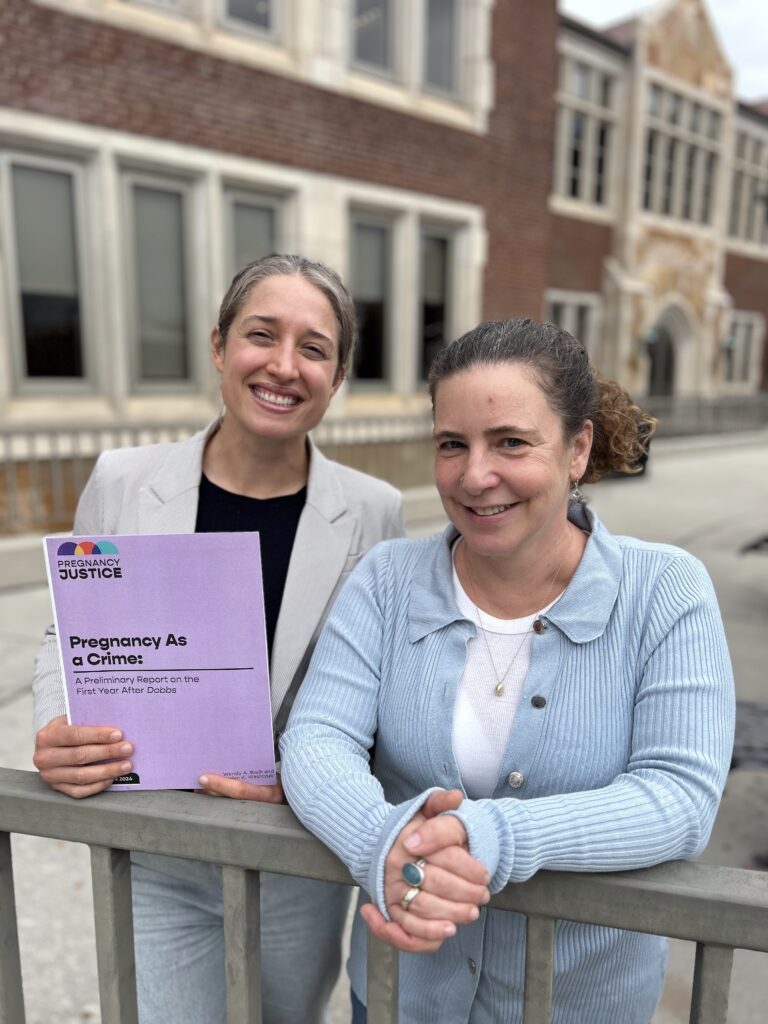
Professor Wendy Bach isn’t new to conversations about the impact of systems of care and punishment on poor communities. Bach’s nearly 30-year career has been dedicated, both in scholarship and practice, to work at the intersections of poverty law, criminal law, and social welfare provision. In 2022 she published her first book, Prosecuting Poverty, Criminalizing Care, which shares findings from Bach’s empirical study of Tennessee’s fetal assault law.
Over the course of studying and writing her book, Bach built relationships with individuals and families who had been criminalized by these laws as well as organizations across the country who offer support to those experiencing pregnancy criminalization. One of those organizations was Pregnancy Justice, a nationwide non-profit dedicated to advancing and defending individuals charged with pregnancy-related crimes.
“After the Dobbs Supreme Court decision, the staff at Pregnancy Justice and I realized there was a need for rigorous research on this topic and decided to see what we could accomplish together,” said Bach.
The resulting project is an expansive transdisciplinary, community collaborative partnership to track cases of pregnancy criminalization across the country. Working across disciplines has allowed the research team to develop and implement novel case identification techniques. The methods established by the team will help other scholars, advocates, and communities identify and research a variety of cases in the criminal legal system.
The transdisciplinary nature of the project also creates compelling training opportunities for UTK students and early career scholars. Dr. Kendra Hutchens joined the project as the Appalachian Justice Research Center’s first postdoctoral research fellow. She leads the qualitative component of the study, to provide data to illuminate the effects of these prosecutions on people’s lives. As a sociologist, Hutchens was drawn to the project for both its unique approach and the opportunity to conduct research that lives in spaces beyond the academy.
“Social scientists do not receive many opportunities for postdoctoral training,” explains Hutchens, “which is an incredible way to learn from others to broaden and deepen your methodological and substantive expertise. As an early career scholar, I feel so grateful to be able to contribute to a project of this scale and scope as part of a transdisciplinary team.”
The project team also consists of law faculty and law students from two universities. Han Lemberg is a 2025 graduate of the University of Tennessee Winston College of Law who worked on the project for a year and a half. Lemberg was the AJRC’s first graduate research assistant and recently began their new role as a public defender at the Kentucky Department of Public Advocacy.
For Lemberg, this project was an opportunity to hone their skills reading and interpreting legal documents, conducting legal research when information was not readily available, and understanding the complexities of criminal code. Importantly, this project also offered Lemberg insights for their law career as a public defender that a classroom alone could not teach.
“Working on this project made me connect the skills I was learning in law school to the realities of the criminal legal system,” shared Lemberg. “It deepened my understanding of how overlapping systems – the family regulation system, law enforcement, the health care system, the school system – can contribute to feelings of fear that impact our clients and create unforeseen barriers to trust-building and representation. As a public defender, it’s critical that I show up for clients with that awareness and the skills to navigate these real-life challenges.”
Like most research at the AJRC, this project brings together law students as well as undergraduate and graduate students in a wide array of disciplines. Perri Mahfouz is a senior in the College Scholars Program who began working on the project after taking the Appalachian Justice Research Lab course. Through the Lab, Mahfouz connected with Bach and expressed her research interest in reproductive health and pregnancy criminalization. Bach recommended a research internship with Pregnancy Justice, and within a few months, Mahfouz was headed to New York City for the summer.
“I plan to go to law school and so getting to have coffee chats with Pregnancy Justice’s policy and legal team staff to hear about their careers and how they got here was a great professional experience,” said Mahfouz. “I think it’s one thing when you’re a student, and you’re constantly dealing with your future career in the abstract, but once you see how that can actually look in the real world, it deepens your understanding of what you want to do.”
This project is exemplar of the kind of research the AJRC was built to hold: research that benefits from the socio-legal expertise of scholars like Bach and Hutchens, students like Lemberg and Mahfouz who are building skills and gaining experience for their careers, and partners like Pregnancy Justice who are deeply connected to communities most impacted by the research issues. In reflecting on the work so far, Bach is struck by how strong the basic idea of community-university collaborations is for the research endeavor.
“For us this project is a model of what can be accomplished when communities and academics come together to ask and answer the questions that are most pressing for individuals directly impacted by policy,” said Bach. “Every day in this project and beyond, we are figuring out how to improve our ability to produce meaningful and impactful research.”
The research team’s work to date is highlighted in two reports, Pregnancy as a Crime: A Preliminary Report on the First Year After Dobbs (September 2024) and Pregnancy as a Crime: An Interim Update on the First Two Years After Dobbs (September 2025). By the end of the study period, the team aims to produce the largest and most comprehensive dataset of pregnancy-related prosecutions that can be used to answer myriad research questions. The unique partnership among Pregnancy Justice and socio-legal scholars ensures that the work of both partners is strengthened by this project – and that the result is applicable and accessible to real communities in Appalachia and beyond.